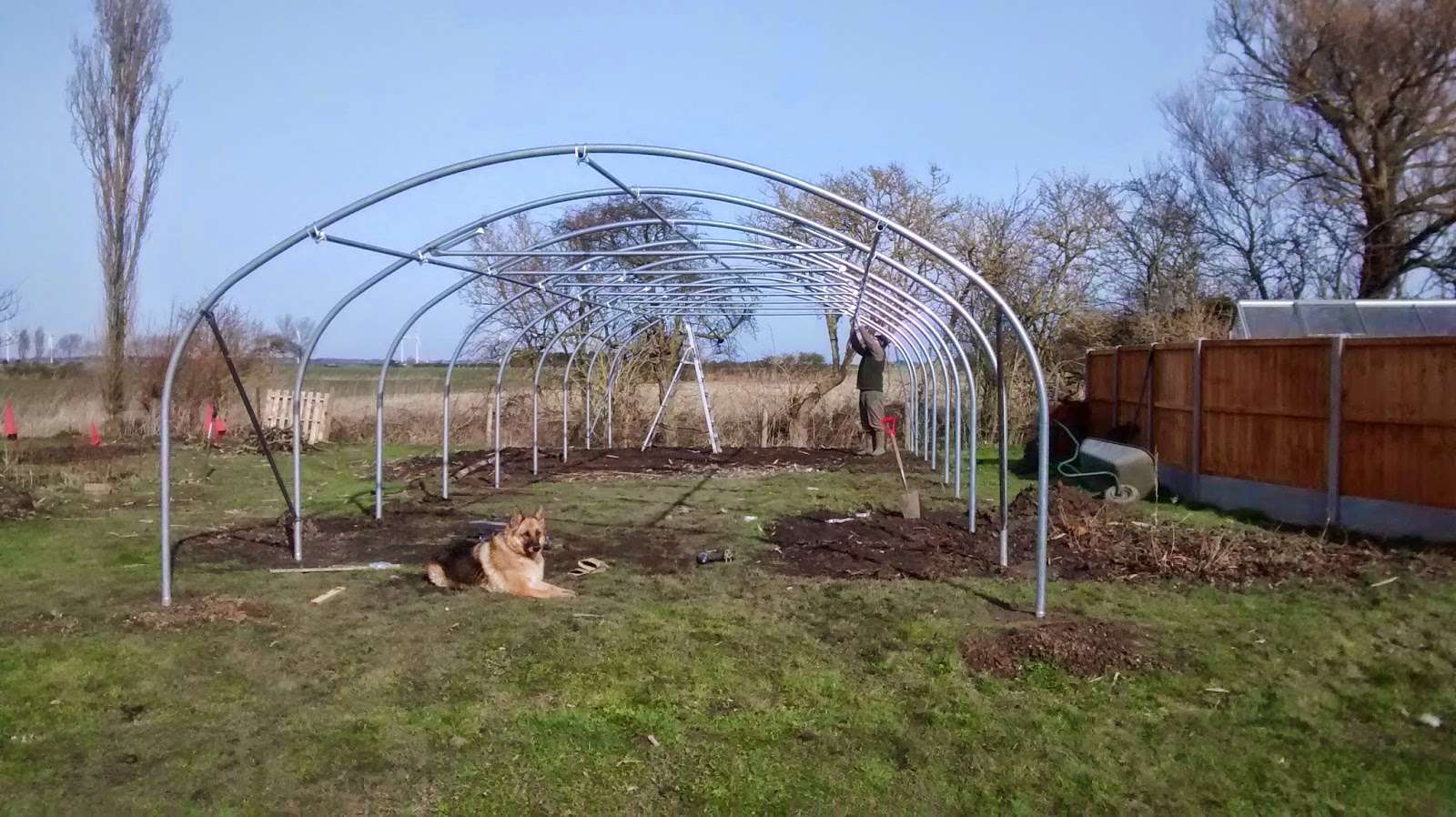
It is a dream I share with my husband, although it is probably more like a passion, that we have become more and more reliant on someone else making our food available for us to buy. We have very little control over the food other than a choice of which sort to buy and from which shop but it is technically all the same, with organic available at a premium. Whilst we are very lucky in this country to have the Red Tractor logo to help us be aware of the origins of our food, it isn't on everything. I always try to buy locally produced food and then British. As a kid growing up in Stevenage, food came from Tescos, bacon came from Holland and lamb came from New Zealand. It was something we were told and it wasn't until much later that I began to ask, but don't we have pigs and sheep in this country? It was a very effective marketing campaign. I was disgusted much later to find that beef routinely comes from Uruguay. Really?? How can that be energy efficient? I have become aware of food miles. We are fortunate enough to be awake at 5.45am, listening to Radio 4, Farming Today and a constant barrage of stories from struggling farmers who have to compete with lamb from New Zealand and pork from everywhere, tumbling dairy prices, horse meat in burgers, pests and diseases plaguing their very existence. Instead of making me want to steer well clear, it has made me want to find out more.
Growing up in the 60s in a new town was far removed of the war time childhoods of my parents. They were both from London and evacuated to the countryside for their own safety. Looking into the lives of people during the war, I was fascinated with the Dig for Victory campaign whereby people were encouraged to grow vegetables wherever they could as a source of food. We were an island under siege as much of the food we imported was being attacked by the enemy. People did what they could. In the 70s the Good Life appeared on our tellies. Our household were regular viewers as Tom and Barbara dug up their suburban garden to become a smallholding. It looked completely insane at the time but it was all setting the seed of things to come. My parents duly dug up the lawn and grew potatoes and tomatoes for a year or two before it was turned back to lawn.
During our first residency here 18 years ago I did have a go at growing some vegetables, beetroot and onions I seem to recall. It was good and I also remember it being the time of my first attempts at jam making, which were very runny. It was a poor attempt but it was a start. There was also a problem with rampant rabbits something which we plan to address.
 |
Our sheltered garden in Tillingham with
greenhouse, abundance of fruit trees and covered chicken run |
When we moved out to Tillingham one of the first things to fall through our letter box was a Flower Show schedule. It was early February and July seemed an age away. When the day grew closer there was a flurry of organised activity as huge marquees were erected and plots marked out on the village playing field. I found a few handicraft items to put into the competition being held in one of the marquees and to my astonishment, I won .... half a cup!! It was more of a cup than I had ever won before but I was hooked. In the subsequent years I never had to share a cup again and won most of the cups available in the handicraft marquee from cooking to photography, handicraft and wine making. In the other marquee were the veg and flowers ....... I managed to win the vegetable cup a few times but the flower cup was to allude me.
Also during this time Hugh Fernley-Whittingstall started his River Cottage series. It was the modern day Good Life. Here was someone who knew nothing about the countryside turning his back on city life and attempting to scratch out an existence, in front of the cameras, with his only skills being as an excellent chef. It was all very contagious. The Jimmy's Farm a little later was pretty much the same thing. The Victorian Farmer, Wartime Farmer and Edwardian Farmer were three series which fascinated me more, especially the Wartime Farmer as it wasn't that far removed from where we are today with the main change being machines to do the hard labour, rather than heavy horses. In these series three historians attempt to live out a year in the life of farmer set at various times. Superb.
About two years ago we heard of the East Essex Smallholders Group. Their meetings were fairly local and monthly. It was at a crucial point for me as I was also thinking of joining the Womens Institute but unfortunately, the meetings clashed on the same day, so we opted for EESG. They are a friendly bunch with a few familiar faces so I felt immediately at home.They have been a constant source of inspiration with Apple Days, venison butchery, pig and lambing talks, farm visits, country shows and an excellent supply of Norfolk Bronze turkeys.
So we were set. We decided to create a smallholding ... somewhere we control what goes into our food, what kind of life our animals have and what they eat. We have had chickens for a few years which have provided us with eggs. They have been hybrids, ex-batts and pedigree birds. They have been free from fox attacks (thus far) and
diseases. We can do this. I can grow vegetables, turn them into wine, jam, chutney and cider. We can keep chickens. We visited the Suffolk Show for several years checking out breeds of sheep and goats and I have been on courses about keeping sheep and goats. Brilliant. Where? Fortunately my inlaws were still living in the remote farmhouse just outside Burnham on Crouch. They have spent a lot of time and energy making the house more energy efficient and lower maintenance over the years. They also have 2.5 acres that they were prepared to divide. They have two horses and the space has been divided so that they still have grazing. I have no interest in horses as I find them a little scary and having had a few incidences with horses, tend to keep my distance. With their advancing years, it seemed the obvious choice to move in with them and use the space to realise our dream.
Our first step is to recreate what we can do already but in our new space, on a much bigger scale. We have our Mission Statement ..... to be self-sufficient in food and energy, and to have as little impact on water usage as possible. We had photo voltaic panels at our old house. Luckily at our new house, they were installed around the same time as ours so benefiting from the higher feed in tariff. Also we have from a small wind turbine at our new space. It is always windy here so that's paying its way. To cover the water aspect of our mission statement, we plan to add rainwater tanks to every down pipe. With a huge demand from the fruit and veg we hope to cover this using rainwater. Phew!! Lots to do. Better get started.